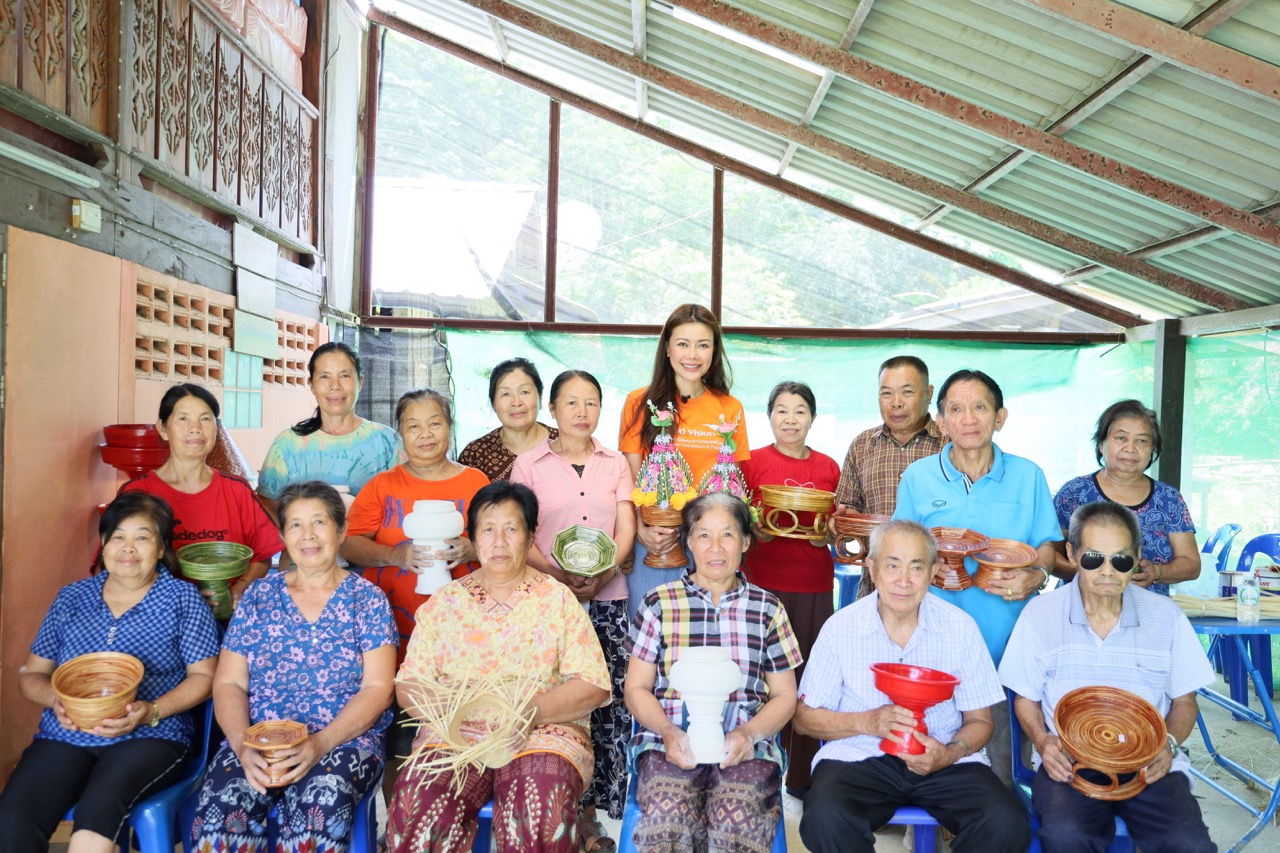
‘Ban Pha Sing Coiled Bamboo Group’ is operating in Tham Wiang Kae Project, Nan Province, led by Somyot Singkharat, also known as Chairman Ko. He shared that the initiative began with a desire to add value to the abundant bamboo found in the community. Despite presenting the idea to several organisations, it was not well received—until 2012, when World Vision Foundation of Thailand was the first to listen and offer support.
That opportunity became the key that unlocked new possibilities for nearly a hundred people in Ban Pha Sing—from Grade 6 students with a passion for craft, to 80-year-old elders still eager to learn. “Age does not matter, as long as you have the heart for it,” Chairman Ko explained his principle for selecting members. Success in handicrafts is not up to age or experience, but about the spirit of learning and commitment.
‘Hamilton’s bamboo’, once overlooked, has now become the star of the project. “Hamilton’s bamboo is ideal for coiling because it is not slippery and stacks neatly,” Chairman Ko explained with pride in his eyes, as if describing a hidden gem found in plain sight.
Each bamboo stalk must be at least two years old, and only the 4th to 7th internodes are usable. This tip was not uncovered overnight—it came from trial and error, observing nature, and sharing knowledge across generations in the community. The process begins by splitting the bamboo into thin strips, which are then coiled into various shapes—from simple coasters to intricate lamps and vases. “We soak them in glue mixed with a special solution to help them bind. This special solution also helps protect against termites, borers, and mould,” Chairman Ko explained.
Auntie Khamla, one of the core members, smiled broadly as she spoke about the income. “We get paid for our work. The rate depends on the detail of each piece.” A lamp earns 60 baht per piece. It may not sound like much, but for a rural community that once relied solely on agriculture, this extra income is like rain in a drought—and it has also become a gathering place for the elderly.
“It makes a huge difference,” Chairman Ko responded without hesitation when asked about the transformation. He raised his fingers to count: “First, it creates jobs for the community. Second, coiled bamboo crafts have been recognised as the top bamboo product in the province. And most importantly, it has become a space where the elderly can find value and self-esteem, developing themselves into expert trainers.”
At the field office of World Vision Foundation of Thailand in Nan, many of the furnishings are made from coiled bamboo—not for cost-saving reasons, but to showcase pride and recognition of the quality of work from Ban Pha Sing.
“We are deeply grateful. Without World Vision Foundation of Thailand, we would not have even started counting 1, 2, 3. Without them, the coiled bamboo group would not exist. Now it is an essential coiled bamboo cluster of Nan Province,”Chairman Ko concluded with his final words filled with heartfelt gratitude. Coiled bamboo has become a treasured craft of the community—a symbol of hope, pride, and the enduring power of transformation.